
PLEXIGLAS®
PLEXIGLAS® is the material of our choice. With PLEXIGLAS® we have material for our advertising displays and information stands. information displays. Flexible and changeable! As early as the 1930s, the company Röhm & Haas AG (today Röhm GmbH) introduced this unbreakable, plastic on the market, which set new accents with its glass-like character, it set new accents. Today the use of PLEXIGLAS® is used in industry, advertising, architecture and art. and it is impossible to imagine life without it. Due to the of advertising displays, information stands and merchandise display stands and product carriers, we have a wide range of blanks in any material thicknesses and sizes, both PLEXIGLAS® XT from from 2.0 mm material thickness or PLEXIGLAS® GS. Our customer service will be happy to advise you.
PLEXIGLAS® Cut to Size
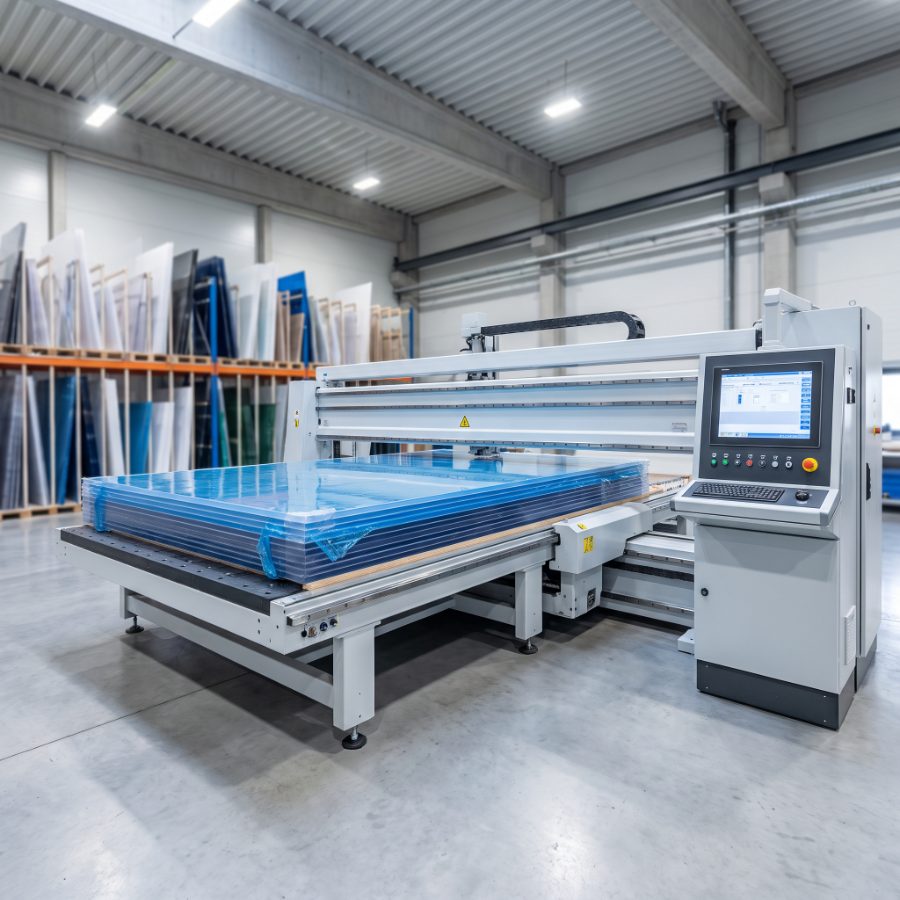
VITAdisplays® cuts PLEXIGLAS® sheets to your dimensions with millimetre accuracy, in nine thicknesses from 2 to 25 mm, five finishes and three edge qualities. The material is the same one our own production uses for brochure holders, merchandise displays and promotional stands.
- 2 – 25 mm
- 5 finishes
- Diamond-polished edge
- Delivery 7 – 10 days

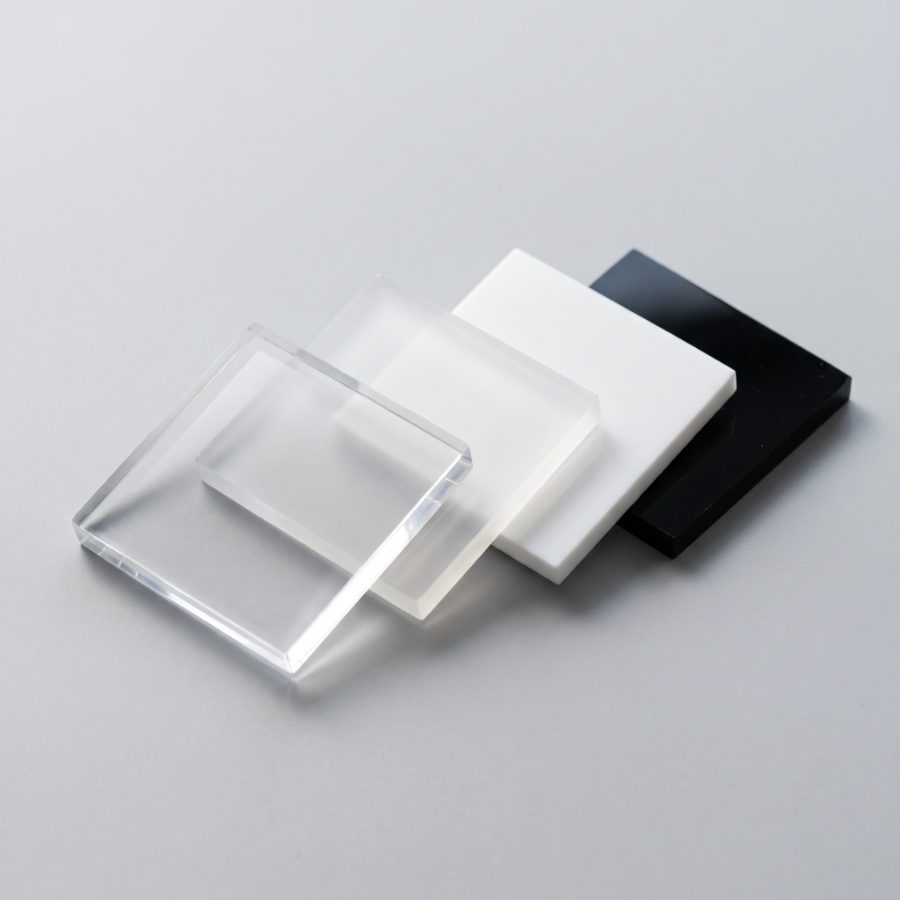
Five finishes and their properties
The five finishes differ mainly in light transmission. Which finish is available in which thickness is shown in the configurator.
 Clear
Clear
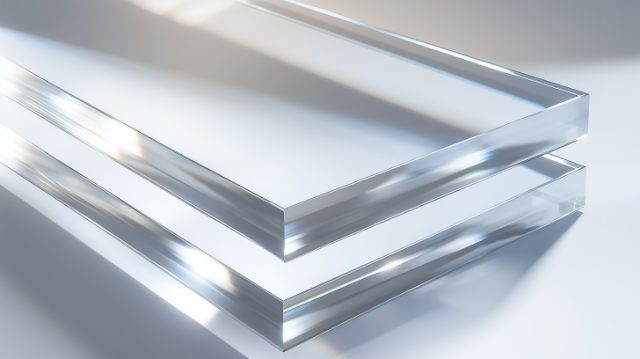
Clear acrylic lets more light through than window glass and suits every application where you need to see through the panel. Typical uses are protective screens, display cases, picture-glass replacement and machine windows.
 Opal
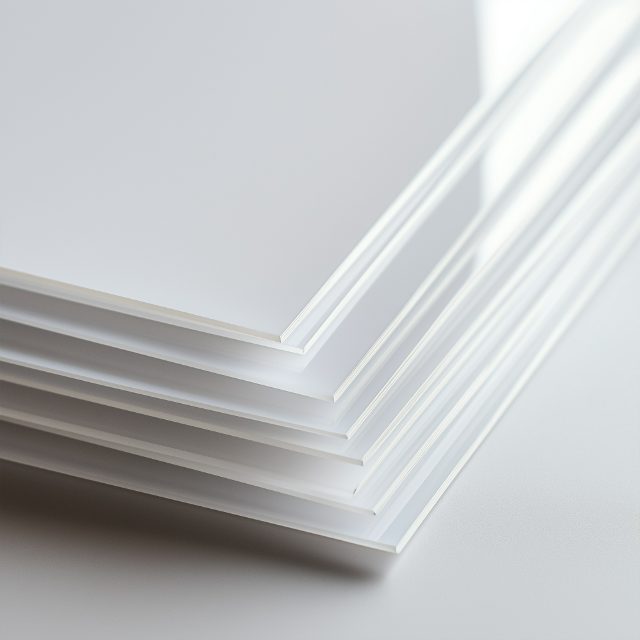
Opal
Opal spreads the light evenly, so that individual lamps do not show through as a bright spot. Typical uses are backlit panels, light boxes and lampshades.
 Satin
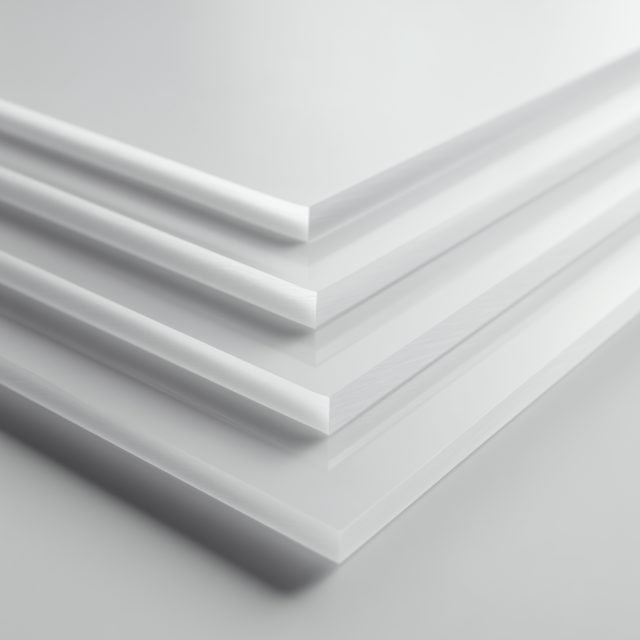
Satin
Satin acrylic is smooth on one side and silk matt on the other. The matt surface reduces reflections in a shop window and screens the view without darkening the room.
 White
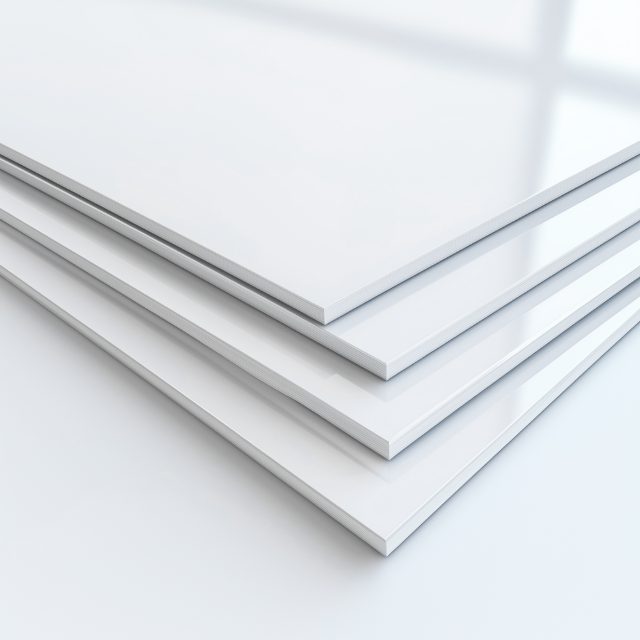
White
White blocks the light completely and forms a bright, calm background. Typical uses are back panels, sign blanks and printed surfaces.
 Black
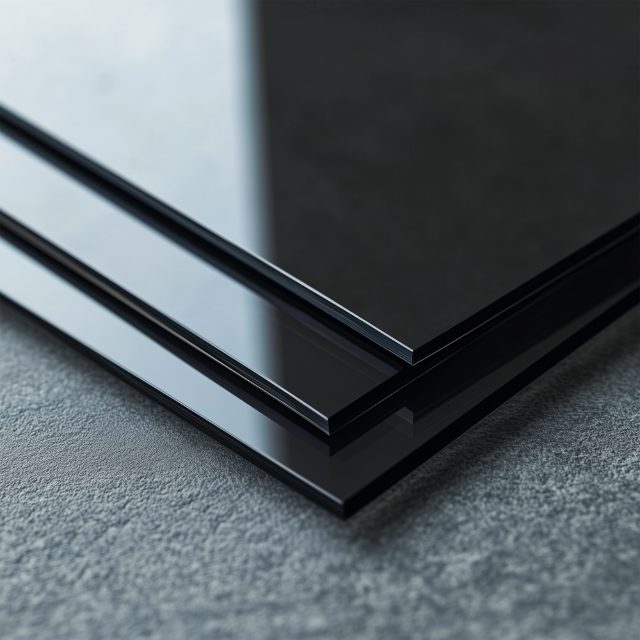
Black
Black has a deep, high-gloss surface that mirrors the product placed on it. The finish is chosen above all for presentation surfaces and plinths.
Edge finishing in three versions
-
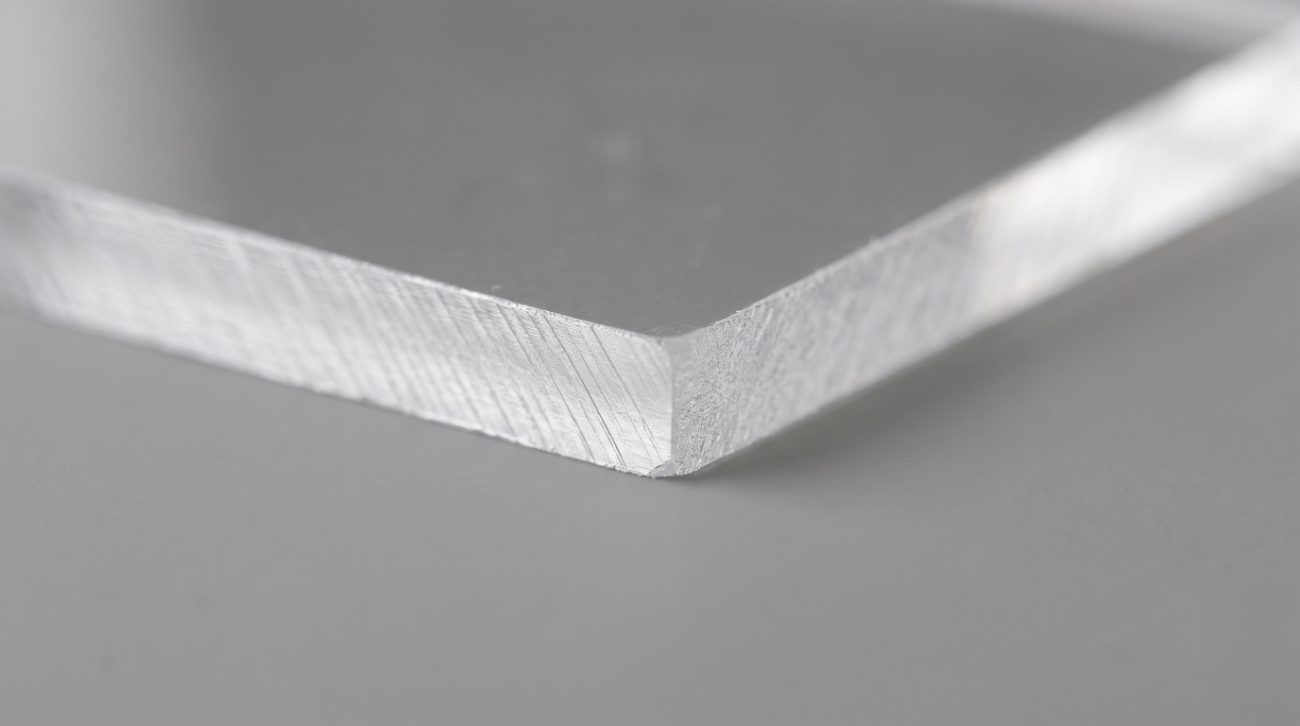
Saw-cut
The cut edge remains unfinished and is matt with fine score marks. This version suits hidden edges, inserts and covers that sit inside a frame.
included -
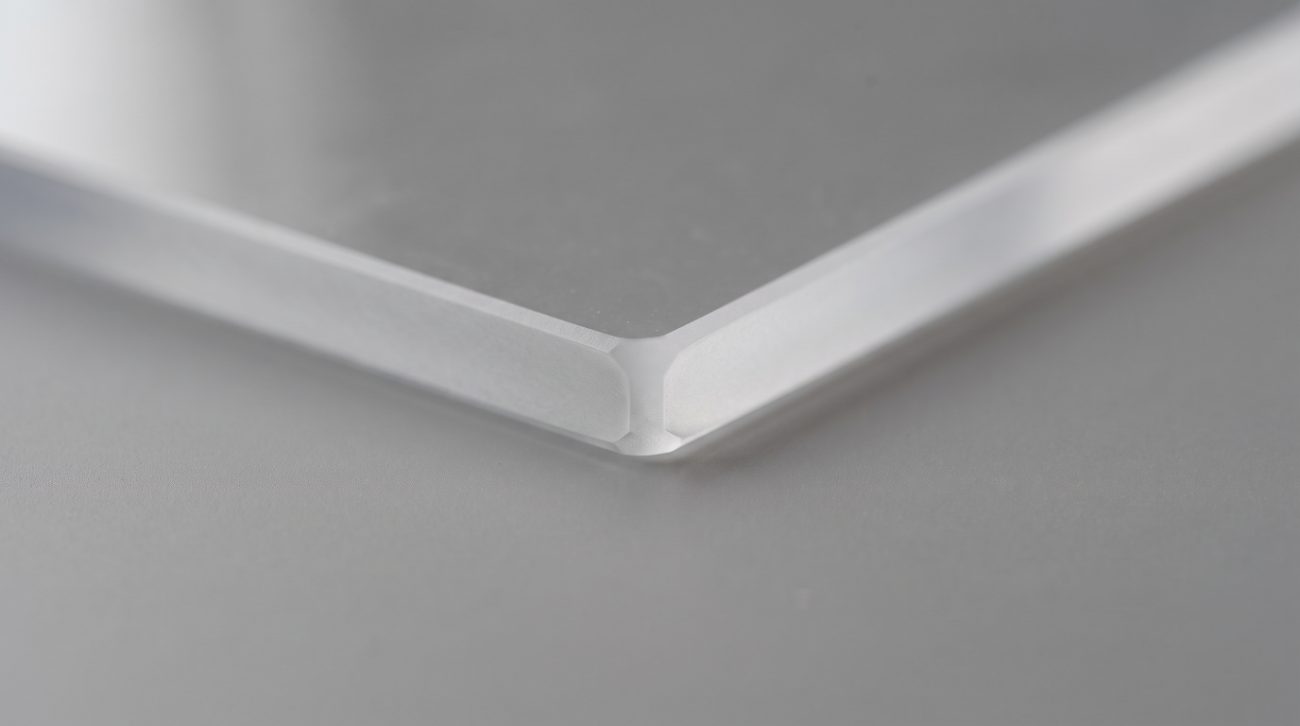
Deburred
The burr is removed, leaving an edge that is evenly matt and safe to handle. Typical uses are protective screens, partitions and covers within reach.
surcharge per metre -
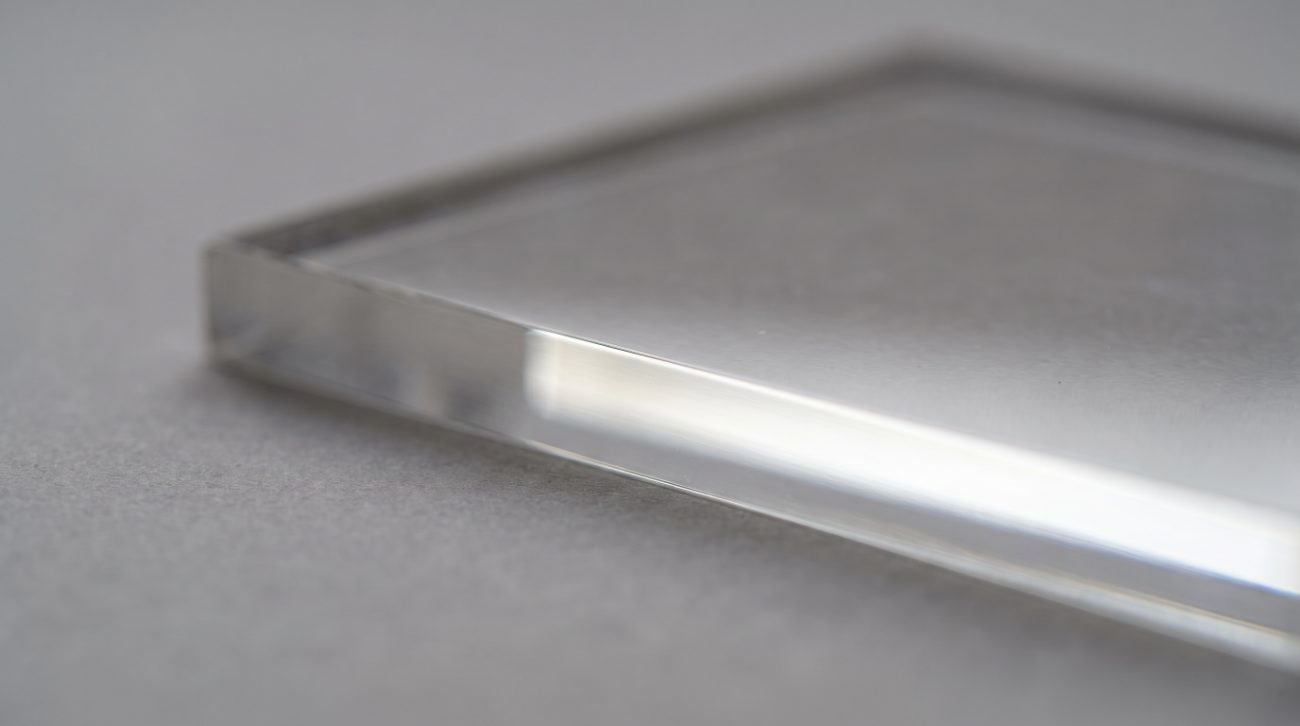
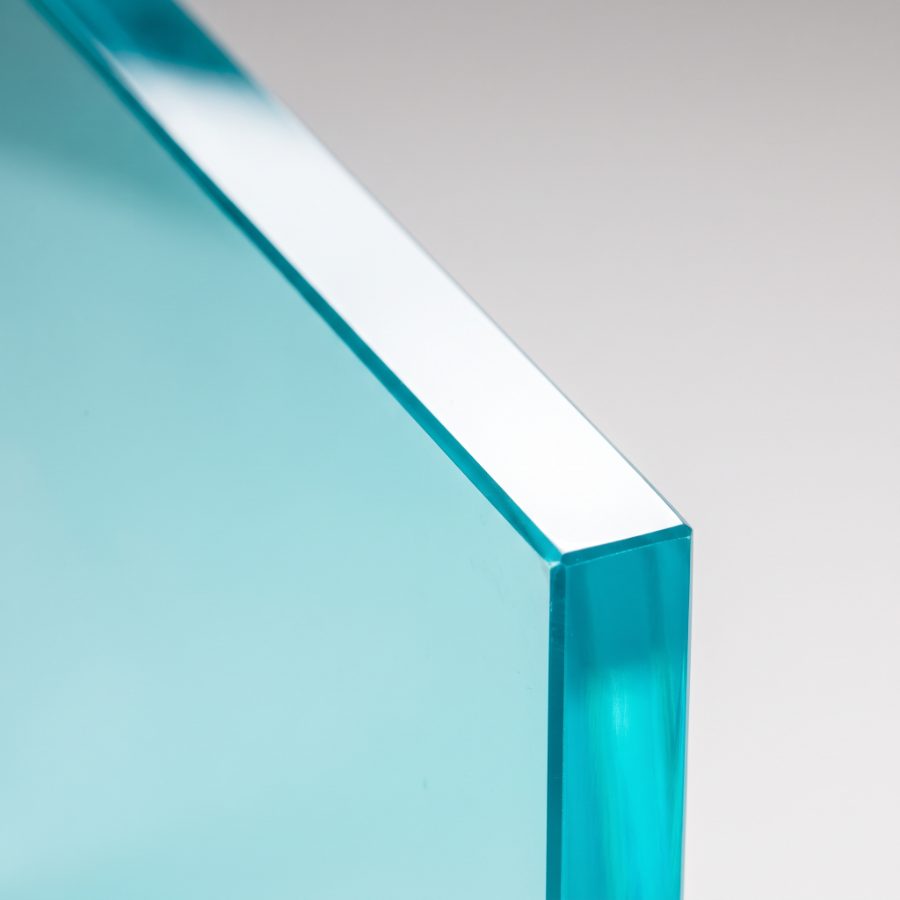
Diamond-polished
The edge is polished until it is clear and therefore looks like the face of the panel. Typical uses are displays, acrylic blocks and free-standing cuts.
surcharge per metre
Polishing is worthwhile on every exposed edge of the cut. It is carried out by machine with diamond tooling, always on all four sides.
Thickness by application
The larger the unsupported area and the heavier the load, the thicker the panel. A cut held in a frame can be thinner than one standing free, and permanent load needs extra reserve.
| Thickness | Typical use | Note |
|---|---|---|
| 2 – 3 mm | Inserts, picture-glass replacement, framed covers, signs up to A3 | light, flexible, always framed or bonded |
| 4 – 5 mm | Protective screens, sneeze guards, partitions up to 1 m, supported shelves | the standard for free-standing panels of medium size |
| 6 – 8 mm | Counter screens, display cases, table-top covers, plinths | stiff enough for unsupported areas without a frame |
| 10 mm | Merchandise displays, acrylic plinths, presentation blocks, machine guards | substantial edge that works as a design feature |
| 20 – 25 mm | Solid blocks, name plates, awards, design objects | solid version, greater thicknesses on request |
- 2 mm to scale
- 5 mm to scale
- 10 mm to scale
- 25 mm to scale
Questions about cutting to size
Advice: +49 4234 93424-14-
Which acrylic do we use?
Our cuts are made from PLEXIGLAS® XT in thicknesses from 2 to 25 mm. XT is extruded, very consistent in thickness and can be cut, milled and drilled cleanly. The satin version in 5 mm is made of PLEXIGLAS® GS, which is cast between two glass plates and reaches a higher flexural strength of 115 MPa. Other GS thicknesses are not available in the configurator.
-
How accurate is the cut?
The manufacturing tolerance is ± 1 mm on width and height. For inserts that have to fit a frame, plan 1 to 2 mm under the inside measurement, because acrylic expands as the temperature rises and would otherwise jam. Sizes are always given as outer dimensions in millimetres, length by width. The chosen edge finish is applied to all four sides, and the protective film stays on both faces until the cut is fitted.
-
Is acrylic shatterproof?
Acrylic is considerably more break-resistant than mineral glass and does not splinter, it breaks into large pieces. For this reason it is used for picture frames, protective screens and machine guards. For higher impact strength, for example in vandalism protection, polycarbonate is the more suitable choice, although it yellows outdoors.
-
Can I use acrylic outdoors?
PLEXIGLAS® is suitable for outdoor use and does not yellow, and the manufacturer guarantees colourless, transparent sheets for 30 years against yellowing. The service temperature range is −40 to +80 °C. Outdoors, panels should never be bolted down rigidly, because the material expands with temperature. Above 40 °C it deforms faster under permanent load, so that a panel in the sun sags sooner.
-
Is acrylic food-safe?
Only transparent PLEXIGLAS® XT is suitable for food contact. According to the manufacturer it meets the requirements of the EU and the FDA, which is why counter screens and food displays are usually made of original PLEXIGLAS®. Tinted, white, black and satin sheets are not approved for direct food contact.
-
How large can a panel be?
Formats up to 2000 × 2000 mm can be ordered directly in the configurator, larger dimensions through customer service. Custom-made shapes, cut-outs and holes are also produced on request. Delivery time depends on the request, and as a rule the standard delivery time for cuts applies.
From measurement to delivery
-
1
Configure
Choose thickness, finish, size and edge, and the price is recalculated as you go. All sizes are given in millimetres, with a manufacturing tolerance of ± 1 mm. For inserts, plan 1 to 2 mm under the inside measurement of the frame. For shelves the bearing surface matters as well and should be at least 10 mm on each side, so that the load does not rest on a single point of the edge. Measure at three places if in doubt, as older frames are rarely exactly square.
-
2
Order
Set the quantity and add the cut to the cart. Shipping costs are shown there, matched to the size, before you complete the order, and there is no minimum order value. The price consists of three parts: the area times the material price, the edge length for the finishing and the cutting costs. With a finished edge a square cut is therefore cheaper than a long, narrow one of the same area, because its perimeter is shorter.
-
3
Made to order
Production takes place after ordering at our own works in Dörverden, with the chosen edge finish on all four sides. Every cut is made individually to your dimensions, so there are no intermediate sizes from stock. The protective film stays on both faces of the panel and is removed only when it is fitted. Cut-outs, holes and rounded corners are produced as a custom order in the same operation, which saves drilling them afterwards.
-
4
Shipping in 7 – 10 days
Cuts are dispatched packed with edge protection as a parcel with GLS or DHL, and delivery takes 7 to 10 days from ordering. If both sides exceed 800 mm or the panel is particularly heavy, delivery is by courier or by freight forwarder on a pallet. Check the consignment for visible transport damage on delivery. Remove the protective film only after fitting and leave it on the panel while drilling, so that the surface is not scratched.


PLEXIGLAS® cuts from our own production
In everyday language almost any transparent plastic is called Plexi. PLEXIGLAS® has been a brand of Röhm GmbH since the 1930s and is made today by Polyvantis GmbH in Germany, whose direct distribution partner VITAdisplays® is. Our own displays are made from this material only, which is why cuts are kept in stock in every thickness. Acrylic cuts are therefore taken from the same material stock that has supplied brochure holders, merchandise displays and stands for decades. The experience from our own display production goes into the advice on thickness, finish and edge treatment.
The difference between XT and GS
XT and GS are both acrylic and differ in the way they are produced. XT is extruded, pressed through a slot die, and achieves tight thickness tolerances at a favourable price. The material is well suited to laser cutting and CNC milling and is our standard from 2 to 25 mm. GS polymerises between two glass plates and has a more uniform structure. Its flexural strength reaches up to 115 MPa, the softening point lies at 115 °C, and GS absorbs less moisture and is easier to bend, bond and polish. For cuts we use XT in all thicknesses from 2 to 25 mm. GS is available as the satin version in 5 mm.
Cleaning and care
Lukewarm water, a drop of mild washing-up liquid and a soft microfibre cloth are sufficient for cleaning, followed by wiping dry. Dust should be rinsed off rather than wiped off dry, because the surface hardness of about 200 HV allows grains of dust to leave scratches. Acetone, ethanol, methanol, methylated spirit, ammonia-based glass cleaner and scouring agents are not suitable. They attack PMMA chemically and cause stress cracks that can no longer be removed. Scratches, unlike those in mineral glass, can be polished out: removing scratches.
Drilling, bonding, bending
Drilling is done with a plastics bit and without hammer action, at least 40 mm from the edge and 50 mm between two holes. The hole should be 2 to 3 mm larger than the screw, because acrylic expands by 0.07 mm per metre and degree. Bonding is done with a solvent adhesive such as Acrifix rather than superglue. Bending is carried out warm at 150 to 180 °C. The protective film usually stays on and is removed only if it would end up inside the bend or be trapped at a tight angle. Further notes: working with acrylic.
Load-bearing and creep
For deflection the span matters more than the thickness, because it enters with the fourth power. Doubling the span leads to sixteen times the deflection, while moving from 5 to 8 mm reduces it to a quarter. The material also creeps: under permanent load the deflection doubles over months, because the modulus of elasticity drops from 3,300 to around 1,650 MPa. Plan shelves with reserve for this reason. Full tables: shelf boards and load-bearing.
Outdoors and in damp rooms
PLEXIGLAS® does not yellow, and the manufacturer guarantees colourless, transparent sheets for 30 years. For wind and privacy screens the thickness follows the area: up to 0.5 m² 6 mm in a profile is sufficient, between 0.5 and 1.5 m² 8 mm is usual, and above that 10 to 12 mm. On the coast and at altitude 12 to 15 mm and a structural check are advisable. Further notes: wind and privacy screens (German).
Delivery and service
Cuts are dispatched packed with edge protection, and the protective film stays on both sides until fitting. There is no minimum order value. Custom-made formats with special shapes, cut-outs or holes and larger quantities are quoted individually. Delivery time depends on the request, and as a rule the standard delivery time for cuts applies. Our customer service advises by phone and e-mail.